
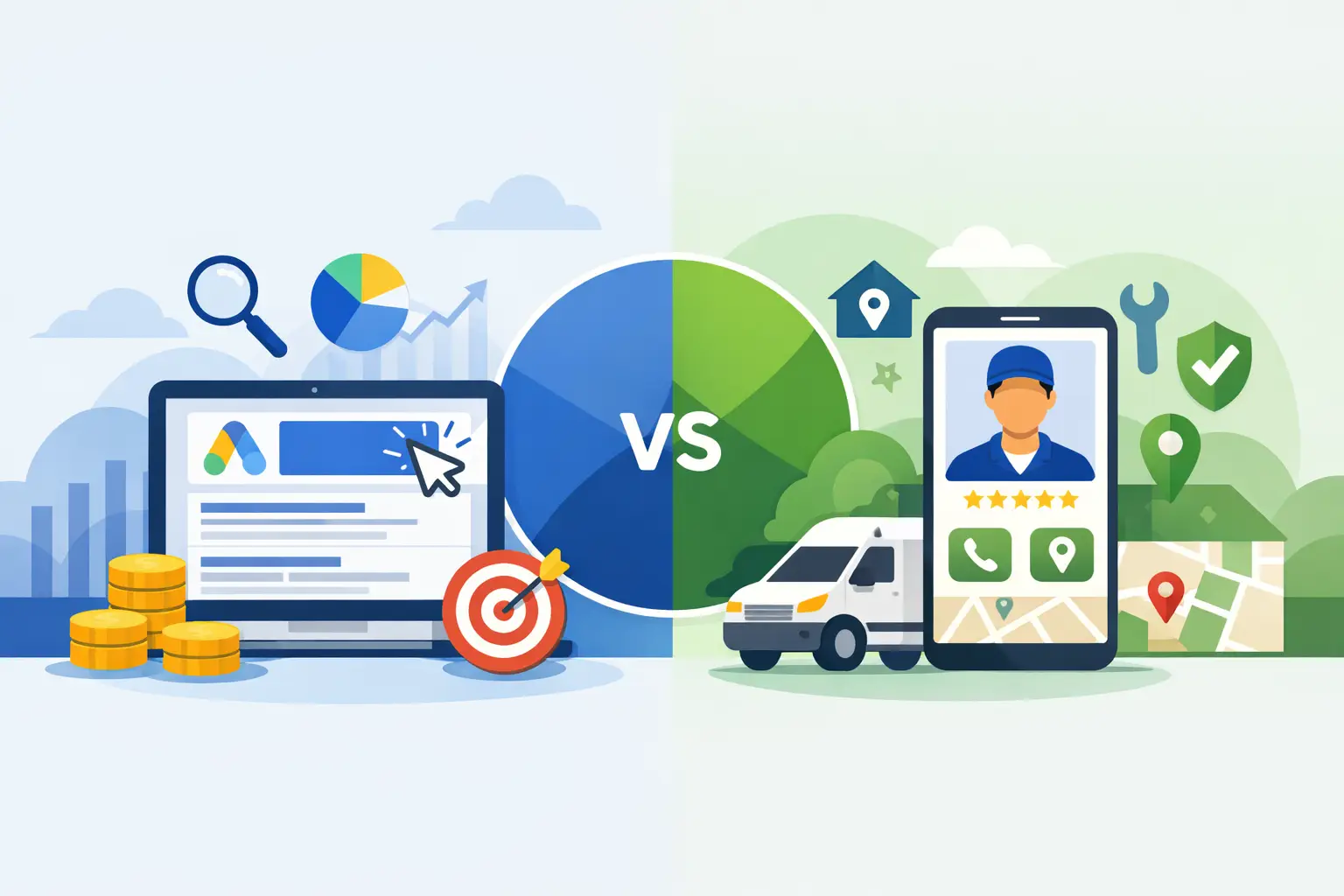
If your phone is not ringing consistently, the question is usually not whether you should advertise on Google. It is where your money should go first. For painting contractors, google ads vs local service ads is not a theory exercise. It affects lead quality, cost per lead, how fast you can get moving, and how many estimates your team can realistically book and run.
A lot of painters hear that Local Service Ads are cheaper and assume that settles it. Others like the control of Google Ads and want to skip LSAs entirely. Both channels can work. Both can waste money if they are set up without a clear plan. The right answer depends on your market, your review profile, your follow-up speed, and what kind of jobs you want more of.
Google Ads vs Local Service Ads for painters
At a basic level, Google Ads puts your business in the sponsored search results when someone types in terms like house painters near me or interior painting company. You usually pay per click. That means you are paying for traffic, not guaranteed leads.
Local Service Ads work differently. They appear at the very top in many service searches, often above traditional search ads. You generally pay per lead rather than per click, and the format is built around calls and message inquiries. For many home service businesses, including painters, that sounds attractive for one simple reason: less wasted spend on curious searchers who never contact you.
That said, cheaper does not automatically mean better. A low-cost lead is not a win if it is outside your service area, wants a tiny touch-up, or never answers the phone when your office calls back.
Where Local Service Ads usually win
For many painting companies, LSAs are the fastest path to more inbound calls from local homeowners. They are especially effective when someone wants help now and is looking for a provider they can trust quickly. The Google Guaranteed badge helps with that. Reviews matter, proximity matters, and your responsiveness matters.
The biggest advantage is simplicity. LSAs are less dependent on heavy keyword management, ad copy testing, and landing page strategy than standard Google Ads. If your goal is straightforward lead flow for residential repaint work in a defined service area, LSAs can produce strong results without as much day-to-day complexity.
They also tend to filter user intent differently. Someone clicking an LSA is often closer to contacting a contractor right away. That can mean less browsing behavior and more direct estimate opportunities.
But there are trade-offs. You get less control over the search terms, the customer journey, and how your business is presented compared with a custom search campaign. Lead disputes can help in some cases, but not every bad lead gets credited. And if your review count is weak or your profile is incomplete, your visibility can stall.
Where Google Ads usually win
Google Ads gives painting contractors more control over the quality and direction of lead flow. You can target specific services like cabinet painting, commercial painting, exterior repainting, or interior projects. You can separate campaigns by location, match ad copy to the search, and send traffic to service-specific landing pages that are built to convert.
That control matters when you want better jobs, not just more inquiries. If you are trying to push higher-ticket exterior projects, commercial repaints, or premium residential work, Google Ads often gives you more room to shape the message and attract the right customer.
It also gives you more data. You can see which keywords are generating calls, which landing pages produce estimate requests, and which campaigns deserve more budget. For a growing company that wants predictable scaling, that level of visibility is useful.
The downside is that Google Ads can burn budget fast if the account is poorly managed. Broad keywords, weak negative keyword lists, slow pages, or generic landing pages can leave you paying for traffic that never turns into an estimate. Google Ads is powerful, but it is less forgiving.
Cost is only half the story
A lot of contractors compare these channels by asking which one is cheaper. That is fair, but it is not enough.
A better question is this: which channel gives you the best cost per booked estimate and the best cost per sold job?
LSAs often look strong on cost per lead. Google Ads may look more expensive upfront. But if your Google Ads leads are better aligned with the services and project sizes you want, they may outperform on actual revenue. A $40 lead that goes nowhere is not better than a $120 lead that turns into a $9,000 exterior project.
This is where most marketing conversations go sideways. The platform matters, but the follow-up system matters just as much. If leads are not answered fast, if estimate requests sit overnight, or if nobody is confirming appointments, both channels will underperform.
Lead quality depends on your setup
Neither platform magically sends perfect prospects. What you get depends on how the campaign is built and how your business operates.
With LSAs, lead quality improves when your service categories are accurate, your service area is tight, your schedule is current, and your review profile is strong. If you cast too wide a net, you will hear from people outside your target range or from low-fit prospects.
With Google Ads, lead quality depends heavily on keyword intent, ad messaging, landing page alignment, and conversion tracking. If someone searches for deck staining and lands on a generic home page about painting services, conversion rates usually suffer. If your ads mention free estimates for full interior repaints and your page reinforces that offer clearly, the traffic is more likely to convert.
For painting contractors, the details matter. Residential and commercial buyers do not search the same way. Interior and exterior jobs have different urgency. A homeowner looking for one bedroom repaint is not the same lead as a property manager sourcing a multi-unit project.
When to choose Local Service Ads first
If you are a residential painting contractor with a solid review base, a verified profile, and a team that answers calls quickly, LSAs are often the right first move. They can generate local demand quickly and are especially useful if your immediate need is more estimate opportunities without a long ramp-up.
They also make sense if your website is weak or your Google Ads setup is not ready yet. Since LSAs are less dependent on landing page performance, they can start producing before every other piece of your marketing system is polished.
Still, they are not ideal in every case. If your market has heavy LSA competition, limited ad visibility, or inconsistent lead quality, relying on LSAs alone can leave you exposed.
When to choose Google Ads first
If you want tighter control, more service-specific targeting, and the ability to grow beyond basic branded local demand, Google Ads is often the better investment. This is especially true for painting companies with multiple service lines, multiple territories, or a need to prioritize certain job types.
Google Ads also makes sense when you have a strong website and a process for turning clicks into calls and form submissions. If you can route traffic to pages built for exterior painting, cabinet painting, or commercial repainting, you can create a more intentional sales pipeline.
For companies trying to scale, this matters. More control over the type of work coming in usually means better use of estimator time and better crew utilization.
The best answer is often both
For many established painting companies, google ads vs local service ads is the wrong framing after a certain point. The better question is how to use both without overlap, waste, or operational breakdown.
LSAs can capture high-intent local calls at the top of the page. Google Ads can cover the service-specific searches, the higher-value jobs, and the keywords where you want stronger message control. When both channels are managed together, you can own more of the search results and reduce dependency on one source.
That only works if the backend is tight. Calls need to be answered. Missed calls need text-back and follow-up. Form leads need fast responses. Reviews need to be actively collected. If not, more lead volume just creates more leakage.
This is why a disconnected marketing approach usually disappoints contractors. Traffic and leads are only part of the job. The real gain comes from connecting ad channels to a working system that books estimates and closes work.
Finish Coat Digital sees this all the time with painters who have tried one platform, got mixed results, and assumed the channel was the problem. Sometimes it is. More often, the problem is the setup, the targeting, or the follow-up after the lead comes in.
If you are choosing between the two, start with your actual bottleneck. If you need faster local lead flow and have the reviews to support it, LSAs may be the right first lever. If you need more control over job type, market targeting, and long-term scaling, Google Ads is usually the stronger foundation. And if your goal is predictable growth, the smartest move is often not choosing sides, but building a system where both channels feed booked estimates instead of missed opportunity.